- Home
Edition
Africa Australia Brasil Canada Canada (français) Català España Europe France Global Indonesia New Zealand United Kingdom United States Skip to content Edition:
Global
Edition:
Global
- Africa
- Australia
- Brasil
- Canada
- Canada (français)
- Català
- España
- Europe
- France
- Indonesia
- New Zealand
- United Kingdom
- United States
Academic rigour, journalistic flair
 Matteo Collina, CC BY-NC-ND
Beyond the beaches, Wellington’s catastrophic sewage spill could be bad news for coastal ecosystems
Published: February 16, 2026 9.45pm GMT
James J Bell, Christopher Cornwall, Ohad Peleg, Te Herenga Waka — Victoria University of Wellington
Matteo Collina, CC BY-NC-ND
Beyond the beaches, Wellington’s catastrophic sewage spill could be bad news for coastal ecosystems
Published: February 16, 2026 9.45pm GMT
James J Bell, Christopher Cornwall, Ohad Peleg, Te Herenga Waka — Victoria University of Wellington
Authors
-
 James J Bell
Professor of Marine Biology, Te Herenga Waka — Victoria University of Wellington
-
Christopher Cornwall
Lecturer in Marine Biology, Te Herenga Waka — Victoria University of Wellington
-
Ohad Peleg
Postdoctoral Research Fellow in Biological Sciences, Te Herenga Waka — Victoria University of Wellington
Disclosure statement
James J Bell receives funding from the Department of Conservation, the Greater Wellington Regional Council, Centerport, The George Mason Charitable Trust and The Royal Society of New Zealand Marsden Fund. He is also supported by a Royal Society of New Zealand Mana Tūārangi Distinguished Researcher Fellowship.
Christopher Cornwall receives funding from the Centre of Research Excellence Coastal People: Southern Skies, the Ministry of Business, Innovation and Employment, the Greater Wellington Regional Council, and Centerport.
Ohad Peleg receives funding from the Centre of Research Excellence Coastal People: Southern Skies and The Royal Society of New Zealand. He has received funding from the Department of Conservation and the Greater Wellington Regional Council.
Partners

Te Herenga Waka — Victoria University of Wellington provides funding as a member of The Conversation NZ.
View all partners
DOI
https://doi.org/10.64628/AA.paqvvm3dk
https://theconversation.com/beyond-the-beaches-wellingtons-catastrophic-sewage-spill-could-be-bad-news-for-coastal-ecosystems-276013 https://theconversation.com/beyond-the-beaches-wellingtons-catastrophic-sewage-spill-could-be-bad-news-for-coastal-ecosystems-276013 Link copied Share articleShare article
Copy link Email Bluesky Facebook WhatsApp Messenger LinkedIn X (Twitter)Print article
Public concern over the total failure of the Moa Point wastewater treatment plant on Wellington’s south coast has been growing, despite this week’s announcement of an independent review.
When the plant failed on February 4, sewage backed up in the main outfall pipeline and flooded the lower floors of the facility. For two days, raw sewage was released from an outfall only five metres from shore at one of the capital city’s most popular kaimoana (seafood) gathering sites.
Discharge was then redirected to a long outfall, which continues to release untreated sewage about a kilometres from the Taputeranga Marine Reserve (green boundary on map below) and within hundreds of metres of ecologically important giant kelp forests.
 This map shows the Moa Point sewage spill along Wellington’s south coast. The pipeline network is shown in red, including the 5-metre and 1.8-kilometre long outfall pipes discharging to the ocean.
Author provided, CC BY-NC-ND
This map shows the Moa Point sewage spill along Wellington’s south coast. The pipeline network is shown in red, including the 5-metre and 1.8-kilometre long outfall pipes discharging to the ocean.
Author provided, CC BY-NC-ND
Nearly one billion litres of untreated sewage have since flowed onto the coast. The discharge continues at roughly 70 million litres per day. Public health warnings have rightly focused on contaminated beaches and risks to swimmers, surfers and shellfish gatherers.
But the potenital consequences extend well beyond beach closures.
Untreated sewage contains elevated nitrogen and phosphorus, organic matter, bacteria, pathogens, microplastics and fine suspended sediments. Released in large volumes, this mixture delivers multiple stressors simultaneously to coastal ecosystems.
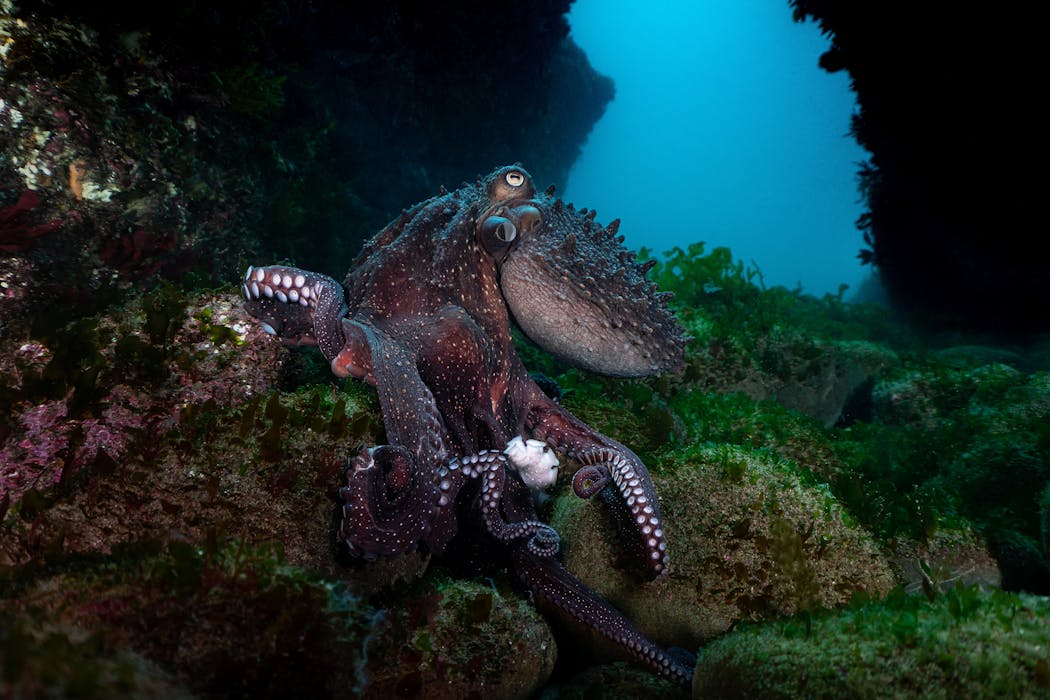
This video shows the trajectory and density of the discharged sewage along Wellington’s coast. Credit: Calypso Science.Wellington’s south coast is dominated by structurally complex habitats including kelp beds in shallow water and sponge gardens on deeper reefs. These habitats function like underwater forests, providing shelter, nursery grounds and feeding areas for ecologically, commercially and culturally important species, including taonga species.
The scale of ecological impacts remains uncertain. It will depend on how much sewage reaches reef systems, how concentrated it is, and how long the discharge continues.
The highly energetic nature of the south coast, with strong Cook Strait tidal currents and heavy wave exposure, may promote mixing and dilution. However, weather variability and shifting circulation patterns add considerable uncertainty.
 The Wellington south coast supports diverse seafloor communities, including dense kelp forests (A), an understory of encrusting filter-feeding communities on rock cracks and crevices (B), and many commercially, recreationally and culturally important species such as blue cod (C) and crayfish (D).
Matteo Collina
The Wellington south coast supports diverse seafloor communities, including dense kelp forests (A), an understory of encrusting filter-feeding communities on rock cracks and crevices (B), and many commercially, recreationally and culturally important species such as blue cod (C) and crayfish (D).
Matteo Collina
Kelp forests
Kelp forests dominate shallow temperate reefs along Wellington’s south coast. Dense kelp canopies support diverse fish and invertebrate communities. When kelp is removed, opportunistic species can rapidly occupy the available space.
International evidence shows sustained nutrient flows can shift reefs away from kelp dominance. In South Australia, Norway, the Baltic Sea and parts of the Mediterranean, nutrient loading has driven transitions from large canopy-forming seaweeds to low-lying algal communities.
These algae represent a simplified, degraded state. Some are opportunistic and short-lived. Others form persistent turf mats that trap fine sediment and chemically inhibit kelp recruitment.
Southern California provides a relevant comparison and shows contrasting responses of kelp forests to wastewater exposure. During the mid-20th century, poorly treated chronic discharge caused widespread loss of giant kelp forests near major outfalls.
Recovery followed improved treatment and offshore relocation of discharges, but varied greatly between locations and was influenced by El Niño temperature anomalies, storms and grazing dynamics.
In 1992, a two-month release of treated effluent into a kelp forest caused no lasting decline of adult kelp but temporarily inhibited germination.
In Wellington, higher sedimentation and turbidity could reduce light penetration and limit kelp growth. Over time, this may favour algal species adapted to low light, gradually altering reef structure.
Deep reefs and sponge gardens
Beyond the shallow fringe lie deeper rocky reef communities living under low light conditions.
Within six kilometres of the Moa Point discharge pipe, these mesophotic reefs host sponge gardens, bryozoans and ascidians that filter seawater and recycle nutrients.
Protected cup corals also occur in these habitats.
Fine sediments and organic matter can settle onto reef surfaces, smothering organisms. Increased turbidity further reduces light penetration, affecting photosynthetic species that already live at their depth limit.
Because many mesophotic organisms grow slowly, recovery from repeated sedimentation events may take years rather than months.
This video was taken before the sewage spill. It shows rocky reefs at 70 metres of depth, about six kilometres from the outflow site.Bacteria, oxygen and microplastics
Untreated wastewater carries elevated bacterial loads and pathogens. While attention often centres on human health, ecological effects are also possible.
Filter feeders such as sponges process large volumes of seawater and may experience physiological stress under sustained contamination.
In shallow, poorly flushed areas near the short outfall pipe, increased organic matter may fuel bacterial growth and reduce oxygen levels. On hot, calm days, when water temperatures rise and oxygen solubility declines, hypoxic conditions may develop.
Sessile or low-mobility species such as pāua are particularly vulnerable.
Wastewater is also a recognised pathway for microplastics, especially synthetic fibres. These particles can be ingested by plankton, shellfish and other filter feeders like sponges, and may move through food webs.
Although long-term consequences are still being investigated, microplastics add another cumulative stress factor.
Marine mammals and seabirds
Wellington’s coastline supports whales, dolphins, seals and seabirds. Pathogens present in wastewater may pose infection risks, particularly in areas of concentrated discharge.
If nutrient enrichment and sedimentation alter kelp forests or fish communities, dolphins, seals and diving seabirds may find less food. Even subtle habitat changes can ripple through food webs.
Large pods of dolphins with more than a hundred individuals are common on Wellington’s south coast. This video was captured in May 2025, about three kilometres from the sewage outflow site.Monitoring impacts
We have already collected ecological baseline data over many years along with the Department of Conservation and Greater Wellington Regional Council. These data provide valuable reference points for detecting ecological change.
Large sewage discharges are often framed as short-term public health crises. However, evidence from temperate coasts worldwide shows nutrient enrichment and sedimentation can drive longer-term ecological shifts, especially when combined with marine heatwaves and storms.
The Moa Point incident may become the largest sewage discharge in modern New Zealand history. Its true impact will not be measured by the number of days beaches remain closed, but by how Wellington’s kelp forests and sponge gardens respond in the years to come.
- Public health
- New Zealand
- kelp forests
Events
Jobs
-
 Deputy Dean (Learning and Teaching)
-
Deputy Editor
-
Director of Professional Development
-
University Librarian
-
Video Commissioning Editor
 Deputy Dean (Learning and Teaching)
 Deputy Editor
 Director of Professional Development
 University Librarian
 Video Commissioning Editor
- Editorial Policies
- Community standards
- Republishing guidelines
- Analytics
- Our feeds
- Get newsletter
- Who we are
- Our charter
- Our team
- Partners and funders
- Resource for media
- Contact us
-
-
-
-
Copyright © 2010–2026, The Conversation