
- Home
Edition
Africa Australia Brasil Canada Canada (français) Català España Europe France Global Indonesia New Zealand United Kingdom United States Skip to content Edition:
Global
Edition:
Global
- Africa
- Australia
- Brasil
- Canada
- Canada (français)
- Català
- España
- Europe
- France
- Indonesia
- New Zealand
- United Kingdom
- United States
Academic rigour, journalistic flair
 When wetlands are drained, carbon-rich sediments are exposed to the air, allowing rapid decomposition and the release of carbon dioxide.
(Ducks Unlimited Canada), Author provided (no reuse)
Draining wetlands produces substantial emissions in the Canadian Prairies
Published: February 16, 2026 3.44pm GMT
Kerri Finlay, University of Regina, Colin Whitfield, University of Saskatchewan, Lauren Bortolotti, University of Saskatchewan
When wetlands are drained, carbon-rich sediments are exposed to the air, allowing rapid decomposition and the release of carbon dioxide.
(Ducks Unlimited Canada), Author provided (no reuse)
Draining wetlands produces substantial emissions in the Canadian Prairies
Published: February 16, 2026 3.44pm GMT
Kerri Finlay, University of Regina, Colin Whitfield, University of Saskatchewan, Lauren Bortolotti, University of Saskatchewan
Authors
-
 Kerri Finlay
Professor, Department of Biology, University of Regina
-
Colin Whitfield
Associate Professor, School of Environment and Sustainability, University of Saskatchewan
-
Lauren Bortolotti
Adjunct Professor, School of Environment and Sustainability, University of Saskatchewan
Disclosure statement
Kerri Finlay receives funding from the Natural Sciences and Engineering Research Council (NSERC) of Canada, Canada Research Chair (CRC) program, Canada Foundation for Innovation (CFI), the Saskatchewan Ministry of Agriculture (Agricultural Development Fund), Saskatchewan Cattlemen's Association (SCA). The research reported here was funded by the National Farmers' Union.
Colin Whitfield receives funding from Canada's Federal Tri-Agencies, Canada Foundation for Innovation, Environment and Climate Change Canada, Agriculture and Agri-Food Canada (Bridge to Land Water Sky Living Lab, Central Prairies Living Lab).
Lauren Bortolotti receives funding from Environment and Climate Change Canada, Alberta North American Waterfowl Management Plan Partnership, and the Prairie Habitat Joint Venture. She is an employee of Ducks Unlimited Canada.
Partners

University of Saskatchewan provides funding as a founding partner of The Conversation CA.
University of Regina and University of Saskatchewan provide funding as members of The Conversation CA-FR.
University of Regina provides funding as a member of The Conversation CA.
View all partners
DOI
https://doi.org/10.64628/AAM.n59kjxrnq
https://theconversation.com/draining-wetlands-produces-substantial-emissions-in-the-canadian-prairies-273549 https://theconversation.com/draining-wetlands-produces-substantial-emissions-in-the-canadian-prairies-273549 Link copied Share articleShare article
Copy link Email Bluesky Facebook WhatsApp Messenger LinkedIn X (Twitter)Print article
The value of wetlands on the landscape cannot be overstated — they store and filter water, provide wildlife habitat, cool the atmosphere and sequester carbon. Yet, in the farmland area of Canada’s Prairies, wetlands are being drained to increase crop production and expand urban development.
While wetlands sequester carbon, they also naturally release greenhouse gases (GHG) into the atmosphere. That means the impact of wetland drainage on net GHG emissions was previously difficult to determine.
Our new study, however, has found that widespread wetland drainage on Prairie farmland releases 2.1 million tonnes of carbon dioxide equivalent (CO₂-eq) per year. That’s equal to more than five per cent of Prairie agricultural emissions from the industry as a whole. CO₂-eq is a metric used to to compare emissions from different greenhouse gases by converting amounts of those gases to the equivalent amount of carbon dioxide.
Our research team included Darrin Qualman from the National Farmers Union, Sydney Jensen, a then-graduate student at the University of Regina, as well as Murray Hidlebaugh and Scott Beaton, independent farmers in the Canadian Prairies.
Some tout wetland drainage as providing numerous benefits to agriculture. In addition to increasing arable land area, proponents argue that “proper drainage management … reduces the carbon footprint by cutting down equipment operation time, fuel and emissions, reduces the impacts of extreme weather events, and decreases overland flooding and nutrient washouts.”
This assertion of the environmental benefits associated with wetland drainage is not supported by science. Our work highlights a large increase in the carbon footprint associated with wetland drainage rather than a reduction, while other work documents impacts on streamflows and nutrient export, and the loss of ducks and other birds.
The impacts of draining wetlands
An explainer on the important role wetlands play in the environment. (Ducks Unlimited Canada)To quantify the net greenhouse gas (GHG) emissions associated with wetland drainage, our approach was to quantify GHG sources when wetlands are intact, and compare them with sources after drainage takes place to understand the net effect of wetland removal on emissions. The annual rate of wetland loss from existing data (10,820 hectares per year) was used to quantify associated carbon emissions for the region.
Intact wetlands emit GHGs such as carbon dioxide, methane and nitrous oxide, so their removal eliminates these natural emissions from the landscape. The presence of wetlands in fields can also require repeated machinery passes and lead to double fertilization around wetland margins, both of which contribute to GHG emissions.
When wetlands are drained, carbon-rich sediments are exposed to the air, allowing rapid decomposition and the release of carbon dioxide. Drainage also expands cropland area, leading to additional GHG emissions from farming activities on the newly cultivated land. It often requires the removal of rings of willow trees surrounding wetlands, with the resulting debris typically burned or composted, producing further emissions.
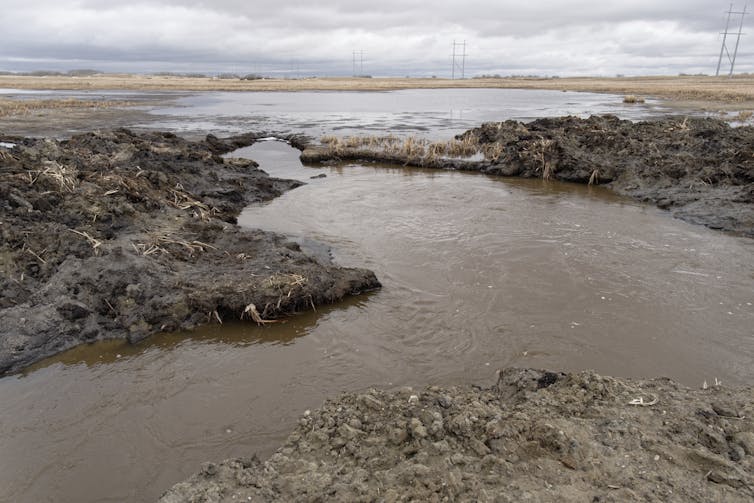 A wetland being drained in the Rural Municipality of Martin, Sask. Some farmers choose to drain wetlands to increase their acreage.
THE CANADIAN PRESS/Michael Bell
A wetland being drained in the Rural Municipality of Martin, Sask. Some farmers choose to drain wetlands to increase their acreage.
THE CANADIAN PRESS/Michael Bell
Our results show that the amount of carbon dioxide released from exposed soil from drained wetlands far exceeded any other source. This was much larger than emissions when wetlands were intact, including natural wetland emissions and emissions from multiple passes with machinery. Additional emissions from farming the former wetland and the removal of vegetation also made a small contribution to the overall balance.
Overall, we estimate that wetland drainage contributes to an annual increase in emissions of at least 2.1 million tonnes CO₂-eq (recognizing that stored carbon will be released over a multi-year period). It is worth noting that this includes natural emissions from intact wetlands, but emissions that are not human-caused are not typically targeted in an effort to achieve GHG reductions.
For example, reducing methane emissions from livestock is a strategy to reduce agricultural GHG emissions, but emissions from wild animals are not considered or incorporated in the same way. Our estimate swells to 3.4 million tonnes of CO₂-eq per year when we exclude natural wetland GHG emissions; this represents an increase of approximately eight per cent above currently quantified GHG emissions from the agricultural industry in the Prairie provinces.
Canada’s GHG Inventory
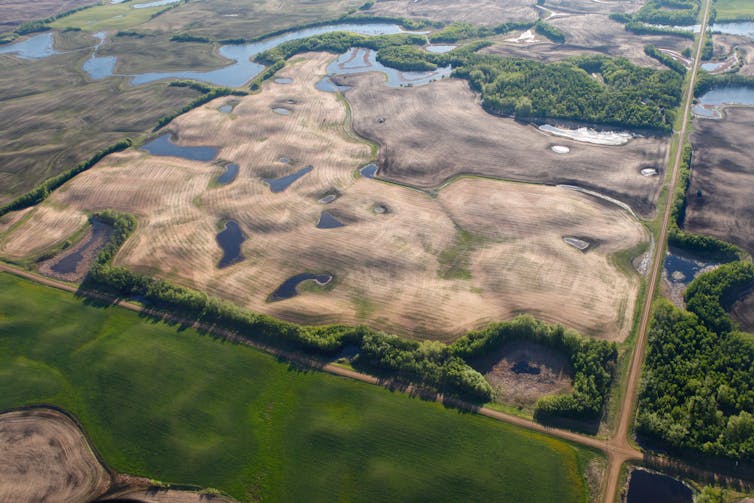 Prairie wetlands in an agricultural field in Alberta. While wetlands sequester carbon, they also naturally release GHGs into the atmosphere.
(Ducks Unlimited Canada), Author provided (no reuse)
Prairie wetlands in an agricultural field in Alberta. While wetlands sequester carbon, they also naturally release GHGs into the atmosphere.
(Ducks Unlimited Canada), Author provided (no reuse)
Canada uses a National Inventory Report to quantify GHG emissions from different jurisdictions and industries, but emissions associated with wetland drainage are not currently included. Emissions of 3.4 million tonnes of CO₂-eq from a single year of wetland drainage are substantial and exceed several emission sources currently described in the report.
For example, emissions from wetland destruction are greater than agricultural emissions from gasoline combustion in trucks or from poultry and swine manure in the Prairie provinces. Including emissions from wetland drainage in the National Inventory Report would provide a more accurate accounting of total agricultural emissions and better position the country to meet its climate commitments.
Prairie farmers play a key stewardship role in this landscape — preserving wetlands on their land provides a public good. Retaining wetlands would create many additional benefits: maintaining wildlife habitats, groundwater recharge, nutrient retention, as well as drought and flood mitigation. These wetland services help address global and regional crises related to biodiversity loss, climate change, lake eutrophication and flooding.
Research shows there is public willingness to pay to restore wetlands in the Prairie provinces. There is additionally a need to reduce conflict and increase collaboration in conversations on agricultural water management in the Canadian Prairies and develop policies that incentivize and enable landowners to consider the environmental benefits of wetlands in their decision making. By better understanding the costs of GHG emissions resulting from wetland drainage, we can better preserve wetlands in the Canadian Prairies.
- Emissions
- Farming
- Wetlands
- Prairies
- Greenhouse gas emissions (GHG)
Events
Jobs
-
 Deputy Dean (Learning and Teaching)
-
Deputy Editor
-
Director of Professional Development
-
University Librarian
-
Video Commissioning Editor
 Deputy Dean (Learning and Teaching)
 Deputy Editor
 Director of Professional Development
 University Librarian
 Video Commissioning Editor
- Editorial Policies
- Community standards
- Republishing guidelines
- Analytics
- Our feeds
- Get newsletter
- Who we are
- Our charter
- Our team
- Partners and funders
- Resource for media
- Contact us
-
-
-
-
Copyright © 2010–2026, The Conversation