- Home
Edition
Africa Australia Brasil Canada Canada (français) Català España Europe France Global Indonesia New Zealand United Kingdom United States Skip to content Edition:
Global
Edition:
Global
- Africa
- Australia
- Brasil
- Canada
- Canada (français)
- Català
- España
- Europe
- France
- Indonesia
- New Zealand
- United Kingdom
- United States
Academic rigour, journalistic flair
 Simon Dawson/Number 10 Downing Street, CC BY-NC-SA
Why the UK has announced a border security deal with China – and what it could mean for small boat crossings
Published: February 16, 2026 12.34pm GMT
David L. Suber, University of Oxford
Simon Dawson/Number 10 Downing Street, CC BY-NC-SA
Why the UK has announced a border security deal with China – and what it could mean for small boat crossings
Published: February 16, 2026 12.34pm GMT
David L. Suber, University of Oxford
Author
-
 David L. Suber
Departmental Lecturer in Criminology, University of Oxford
Disclosure statement
David L. Suber receives research funding from the Leverhulme Trust and from the John Fell Fund at the University of Oxford.
Partners

University of Oxford provides funding as a member of The Conversation UK.
View all partners
DOI
https://doi.org/10.64628/AB.ju5rqvdke
https://theconversation.com/why-the-uk-has-announced-a-border-security-deal-with-china-and-what-it-could-mean-for-small-boat-crossings-275590 https://theconversation.com/why-the-uk-has-announced-a-border-security-deal-with-china-and-what-it-could-mean-for-small-boat-crossings-275590 Link copied Share articleShare article
Copy link Email Bluesky Facebook WhatsApp Messenger LinkedIn X (Twitter)Print article
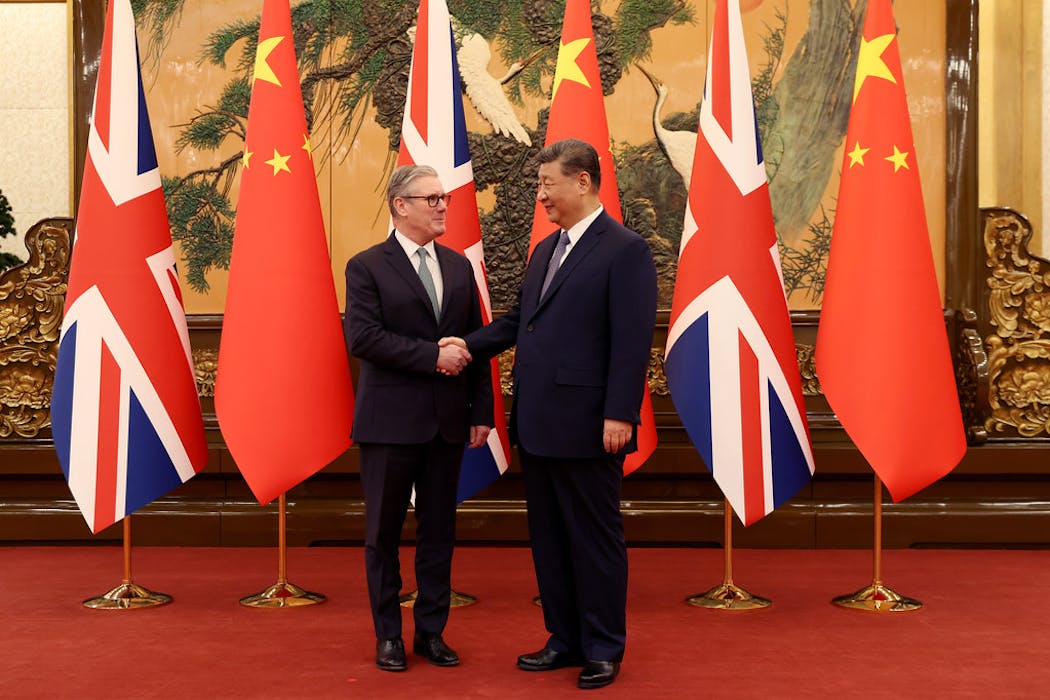
The UK’s prime minister, Keir Starmer, recently visited China to announce what was described as a reset in relations between London and Beijing. Among the economic and diplomatic announcements was a surprising element: a new agreement on border security.
Under the deal, the UK and China committed to closer cooperation to disrupt the supply of engines and equipment used in small boat crossings of the English Channel.
Numbers of small boat arrivals to the UK in 2025 were the second-highest on record. The prime minister is under pressure to deliver on his commitment to “smash the gangs” and reduce unauthorised arrivals.
At first glance, China might appear an unlikely partner in this regard. Chinese nationals are nowhere close to the top nationalities crossing the Channel by small boat.
But the agreement is part of the British government’s efforts to tackle people smuggling by targeting the global supply chain of small boats and engines used for crossings. The aim is to disrupt Channel crossings well before migrants reach the French coast.
Engines and dinghies recovered in the Channel often carry serial or registration numbers. These can be traced back through distributors and intermediaries to manufacturers, many of which are based in China. The UK-China agreement broadly involves sharing intelligence to identify suspect sales of engines by Chinese manufacturers.
For several years, disrupting supply chains has been a central pillar of UK countersmuggling policy. From an enforcement perspective, this approach has obvious appeal. If there are no boats, engines, life vests or fuel, crossings cannot happen.
The logic behind this strategy is to drive up the prices of crossing the Channel, making it unaffordable for migrants and refugees and hijacking the smugglers’ business model.
The deal with China builds on a growing web of agreements the UK has with countries along the migration routes leading to the Channel. In 2023, it signed a similar border security deal with Turkey, focused on sharing intelligence to allow the Turkish authorities to intercept shipments of dinghies and engines manufactured in China.
Both Conservative and Labour governments then went on to expand Project Invigor, the National Crime Agency-led international taskforce, to target organised immigration crime. Border security deals were extended with countries in the western Balkans as well as Iraq, Tunisia, Romania and Bulgaria, and France.
Last year, the Labour government also expanded its global sanctions list, allowing asset freezes, travel bans and other financial restrictions against individuals and companies involved in smuggling from abroad.
Stopping the boats
The crucial question is whether these strategies will achieve the stated goal of reducing Channel crossings. Disrupting supply chains only works if partner states are willing and able to investigate, prosecute and seize.
Research on migrant smuggling consistently shows that deterrence rarely eliminates demand. On the contrary, it increases demand for smugglers’ services. People still attempt the journeys – what changes is how they travel.
Years of independent monitoring by journalists and migrant support groups – including Alarmphone, Captain Support and Calais Migrant Solidarity – point to a clear link between the surge in British and European investment aimed at stopping unauthorised maritime crossings, and the rising number of deaths in the Channel.
Efforts to choke off equipment supplies and intensify policing might lead to reduced number of crossings, but also create the conditions in which they become more lethal: overcrowded inflatables, rushed departures, violence on beaches and a narrowing of options for those unable to pay smugglers.
Read more: Deaths of 31 people in UK’s worst small boat disaster caused by government’s ‘systemic failure' – the Cranston inquiry conclusions explained
Supply-chain crackdowns in the central Mediterranean, often driven by European agreements with key transit countries such as Tunisia and Libya, have coincided with shifts towards heavier, improvised and less seaworthy vessels. For example, “metal boats” used to cross the Mediterranean are often assembled by migrants themselves, and are much more prone to sinking than wooden boats.
 Law enforcement in the Channel has led smugglers to pack more people onto small boats.
Yoan Valat/EPA-EFE
Law enforcement in the Channel has led smugglers to pack more people onto small boats.
Yoan Valat/EPA-EFE
When more than 380 people shipwrecked in the Central Mediterranean last week during cyclone Harry, political responses focused on accusing smugglers for allowing departures in dangerous weather.
Yet organisations working on the ground, as well as migrants themselves, point out that setting off during rough weather conditions has increasingly become a strategy to evade coastal patrols and pushbacks from Tunisian or Libyan police. Similarly, migrants have reported crossing mountainous borders during winter blizzards to avoid detection on the Turkey-Iranian border.
In the Channel, this pattern is already evident. As boats and engines become harder to obtain, supply tightens while demand remains. The result has been chronic overcrowding, deteriorating equipment quality, and increasingly chaotic launch conditions. Fewer boats do not mean fewer people attempting to cross – they mean more people per boat.
From the government’s perspective, cooperating with China fits neatly into its “smash the gangs” approach to people smugglers. But supply-chain disruption is not a neutral technical fix. In practice, it is likely to make those attempting to cross borders turn to more dangerous methods.
If the UK wants to reduce irregular arrivals and deaths in the Channel, supply chain crackdowns and enforcement will not be enough. The visa schemes for Hong Kong residents, and Ukrainian and Afghan refugees suggest that when lawful pathways are available, irregular journeys like small boat crossings lose their appeal.
Expanding safe and legal routes for the main nationalities seeking asylum to the UK should be tested to see if this holds true.
- Border control
- UK migration
- UK-China relations
- Channel crossings
- UK asylum
- small boat crossings
Events
Jobs
-
 Deputy Dean (Learning and Teaching)
-
Deputy Editor
-
Director of Professional Development
-
University Librarian
-
Video Commissioning Editor
 Deputy Dean (Learning and Teaching)
 Deputy Editor
 Director of Professional Development
 University Librarian
 Video Commissioning Editor
- Editorial Policies
- Community standards
- Republishing guidelines
- Analytics
- Our feeds
- Get newsletter
- Who we are
- Our charter
- Our team
- Partners and funders
- Resource for media
- Contact us
-
-
-
-
Copyright © 2010–2026, The Conversation